A friend asks to be paid in SOL. A customer offers USDC. A headline talks about Bitcoin. All three involve crypto, but they do not do exactly the same job. Understanding those differences is more useful than memorising a long list of coin names.
This guide starts with how a cryptocurrency works, then uses SOL, BTC, USDC and USDT to explain the choices you meet when making a payment. You will also learn where a wallet such as SOLKEEP fits in.
A digital asset with a shared record#
A cryptocurrency is a digital asset tracked on a blockchain. Instead of one account provider keeping the only record, a network of computers checks transfers using shared rules. The record shows which addresses hold assets and how those assets move.
Cryptography helps prove that a payment was authorised by the holder of the right key. It also helps the network detect changes to its records. It does not make an asset valuable, hide every payment or guarantee that a project is trustworthy. Our blockchain guide explains the shared record in more detail.
A wallet is your tool for using that record. Your receiving address tells other people where to send funds. Your private keys let you authorise spending. With a self-custodial wallet, protecting those keys and their recovery backup is your responsibility.
What happens when you send crypto?#
Imagine sending a small amount of SOL to a friend. You do not attach a digital coin to a message. You ask the network to update its record: reduce the amount you control and increase the amount at your friend's address.
- You enter the recipient's address and an amount in your wallet.
- You review the payment and its fees, then approve it with your keys.
- The wallet submits the signed payment to the network.
- The network checks it and records the transfer if it is valid.
A confirmation means the network accepted the transfer. It does not mean someone checked whether you meant to pay that person. An incorrect address can still be valid, and a completed payment generally has no chargeback button.
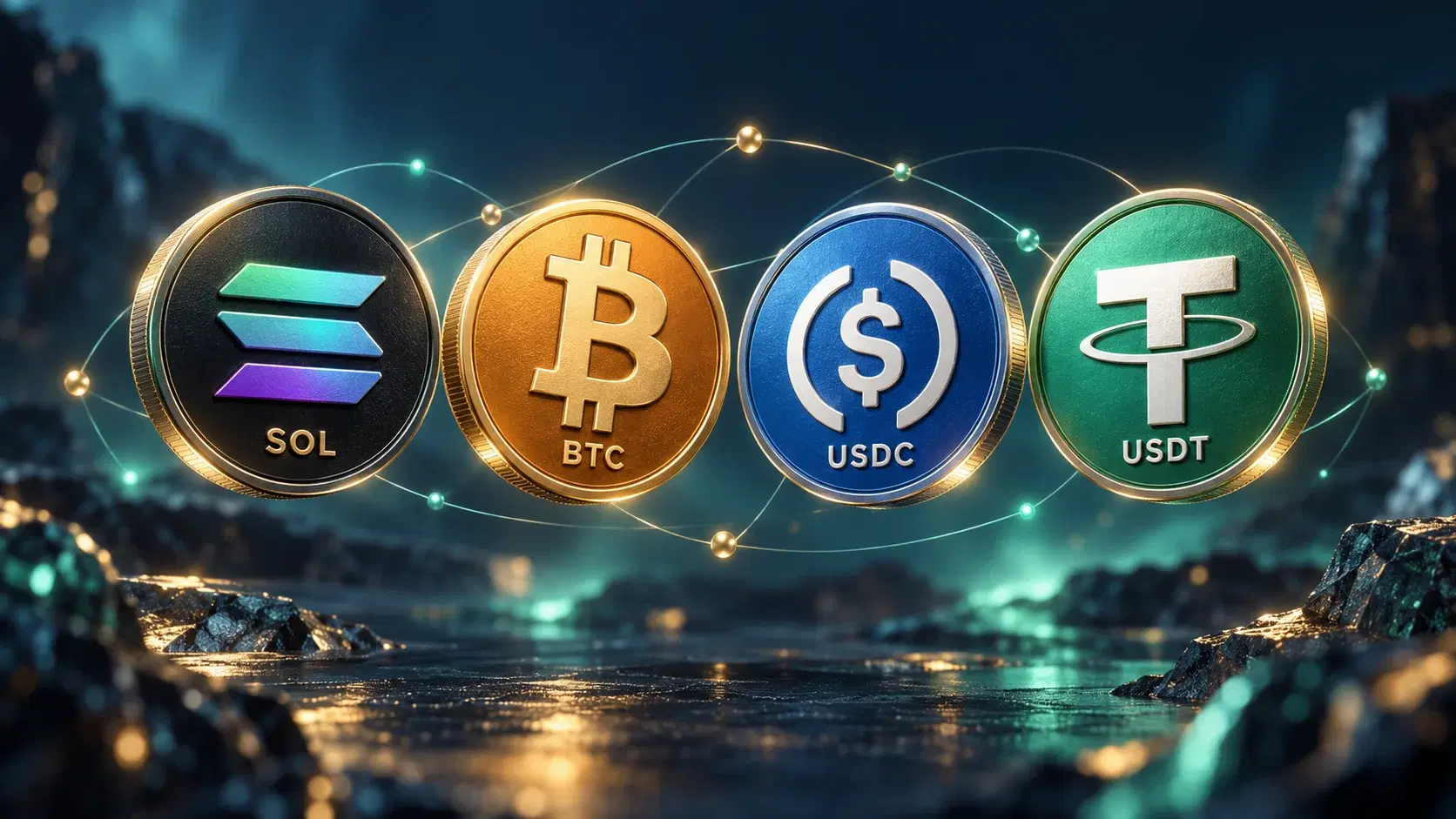
SOL, BTC, USDC and USDT, explained#
| Asset | What it is | What to remember |
|---|---|---|
| SOL | Solana's native coin, used for payments, network fees and staking. | Its price changes. Keep some available to pay Solana network fees. |
| BTC | Bitcoin's native coin, used to transfer value on the Bitcoin network. | Its price changes. Native BTC does not belong at a Solana receiving address. |
| USDC | A stablecoin designed to follow the value of one US dollar. | Available on several networks. Check the network and the genuine asset. |
| USDT | A separate stablecoin also designed to follow the US dollar. | Has its own issuer and reserves. It is not interchangeable with USDC. |
SOL and BTC are native coins: each belongs to its own blockchain. USDC and USDT are tokens issued on existing networks. Seeing the same token name on two networks does not mean you can send it directly between them.
The Bitcoin FAQ explains BTC, and this Solana introduction covers SOL's network. For the stablecoins, read the USDC overview and USDT reserve information.
Why does a cryptocurrency have value?#
A market price forms when buyers and sellers agree to trade. People may want an asset to pay network fees, use an application, transfer money or hold it because they expect future demand. Expectations can change quickly, so usefulness and price do not always move together.
Supply matters too. Bitcoin's rules limit total issuance to 21 million BTC. Other assets follow different supply schedules; some can create more units over time. A limited supply alone does not guarantee demand, safety or a rising price.
Stablecoins take a different approach: their issuers aim to maintain a link to another asset through reserves and redemption arrangements. That introduces a reliance on the issuer, even when transfers happen on a public blockchain.
What can you use crypto for?#
You can send value to another compatible wallet, receive a customer payment or use an application that accepts the asset you hold. A freelancer might price an invoice in USDC to avoid quoting a changing SOL amount. A friend might send SOL because both people already use Solana wallets.
There are practical limits. The recipient needs a way to use or convert the asset. Exchange and conversion fees may apply. Paying an invoice with a token also does not automatically resolve any tax or recordkeeping obligations that apply where you live.
Try a small Solana payment with SOLKEEP#
SOLKEEP is a self-custodial Solana wallet. It keeps an encrypted vault in your browser and signs transactions on your device. You can use it to manage Solana holdings, review swaps and receive payments without handing control of your wallet keys to SOLKEEP.
- Open SOLKEEP, create a wallet and record your recovery phrase offline. Complete the backup check before funding it.
- Copy your receiving address. At the sending service, choose the correct asset on Solana and send a small test first.
- Keep some SOL for network fees, even if your payment will be in USDC or USDT. Check all fees shown before approving a transfer or swap.
- To request a customer payment, choose Get paid, select SOL, USDC or USDT, enter the amount and share the payment link. The payment goes directly to your wallet. SOLKEEP charges no payment-link fee; the payer still pays applicable network fees.
SOLKEEP is for Solana assets; it is not a native Bitcoin wallet. Read the wallet FAQ for current supported transfers and fees. If you are deciding where to keep larger holdings, our crypto storage comparison explains hardware wallets, software wallets and exchange accounts.
Four checks before you send#
- Asset: verify what you are holding. A familiar name or logo can be copied by an unrelated token.
- Network: confirm that the sending and receiving services both support that asset on the same network.
- Recipient and cost: check the address against a trusted source, the amount and the total fees. Avoid copying an address from an unfamiliar transaction in your history.
- Approval: read what the wallet asks you to sign. Stop if a routine payment unexpectedly asks for broader permissions.
Begin with a small amount and learn the full path from receiving to sending. Knowing which asset you own, which network it uses and who controls the keys gives you a useful foundation for every next step.
Further reading: this introductory cryptocurrency guide offers another overview of the basic concepts.
Frequently asked questions
Do I have to buy a whole coin?
No. Many cryptocurrencies can be divided into small fractions. You can hold part of a SOL or BTC, for example. The service you use may still set a minimum purchase or withdrawal amount, and fees matter more on small transfers.
What is the difference between a coin and a token?
A coin is the native asset of a blockchain, such as SOL on Solana or BTC on Bitcoin. A token is issued on an existing blockchain. USDC and USDT are examples of tokens available on several networks.
Can I send Bitcoin to my SOLKEEP address?
Do not send native BTC to a SOLKEEP address. SOLKEEP is a Solana wallet, while native BTC uses the Bitcoin network. A token representing BTC on another network is a different asset with additional risks; a matching name does not establish compatibility.
Are USDC and USDT guaranteed to stay at one dollar?
No. They are designed to track the US dollar, but market prices can move away from that target. Their value also depends on reserves, redemption arrangements and the issuer. They are separate assets, and holding either is different from keeping dollars in a bank account.
Is using crypto anonymous?
Public blockchains show addresses, balances and transaction histories. An address may not display your name, but payments and other public information can connect it to your identity. Sharing a wallet address does not make its activity private.